
Control Charts
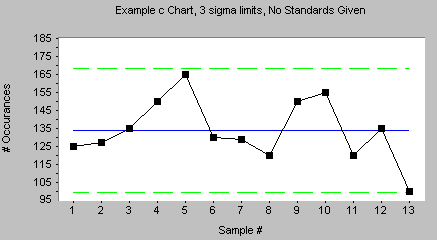
Every process varies. If you write your name ten times, your signatures will all be similar, but no two signatures will be exactly alike. There is an inherent variation, but it varies between predictable limits. If, as you are signing your name, someone bumps your elbow, you get an unusual variation due to what is called a "special cause". If you are cutting diamonds, and someone bumps your elbow, the special cause can be expensive. For many, many processes, it is important to notice special causes of variation as soon as they occur.
There's also "common cause" variation. Consider a baseball pitcher. If he has good control, most of his pitches are going to be where he wants them. There will be some variation, but not too much. If he is "wild", his pitches aren't going where he wants them; there's more variation. There may not be any special causes - no wind, no change in the ball - just more "common cause" variation. The result: more walks are issued, and there are unintended fat pitches out over the plate where batters can hit them. In baseball, control wins ballgames. Likewise, in most processes, reducing common cause variation saves money.
Happily, there are easy-to-use charts which make it easy see both special and common cause variation in a process. They are called control charts, or sometimes Shewhart charts, after their inventor, Walter Shewhart, of Bell Labs. There are many different subspecies of control charts which can be applied to the different types of process data which are typically available.
All control charts have three basic components:
- a centerline, usually the mathematical average of all the samples plotted.
- upper and lower statistical control limits that define the constraints of common cause variations.
- performance data plotted over time.
Things to look for:
The point of making control charts is to look at variation, seeking special causes and tracking common causes. Special causes can be spotted using several tests:
- 1 data point falling outside the control limits
- 6 or more points in a row steadily increasing or decreasing
- 8 or more points in a row on one side of the centerline
- 14 or more points alternating up and down
In those charts that pair two charts together, you will want to look for these anomalies in both charts.
The simplest interpretation of the control chart is to use only the first test listed. The others may indeed be useful (and there are more not listed here), but be mindful that, as you apply more tests, your chances of making Type I errors, i.e. getting false positives, go up significantly.
Types of errors:
Control limits on a control chart are commonly drawn at 3s from the center line because 3-sigma limits are a good balance point between two types of errors:
- Type I or alpha errors occur when a point falls outside the control limits even though no special cause is operating. The result is a witch-hunt for special causes and adjustment of things here and there. The tampering usually distorts a stable process as well as wasting time and energy.
- Type II or beta errors occur when you miss a special cause because the chart isn't sensitive enough to detect it. In this case, you will go along unaware that the problem exists and thus unable to root it out.
All process control is vulnerable to these two types of errors. The reason that 3-sigma control limits balance the risk of error is that, for normally distributed data, data points will fall inside 3-sigma limits 99.7% of the time when a process is in control. This makes the witch hunts infrequent but still makes it likely that unusual causes of variation will be detected.
If your process is in control, is that good enough? No. You have to start by removing special causes, so that you have a stable process to work with. But then comes the real fun, and often the most substantial benefits: it is time to improve the process, so that even common cause variation is reduced.
Recommended Reading:
SkyMark is a software company based in Pittsburgh, Pennsylvania which focuses on creating software tools that help people improve the way they work.
Useful Links
2026 © SkyMark Corporation. All Rights Reserved.