
Why has there been an explosion of interest in management?
by Steve David and Susan Dwyer, SkyMark
The US mints something like 70,000 new MBA's each year. The management literature has ballooned. Tom Peters commands astronomical fees. Why? Because rapid specialization has big expensive crippling side-effects which have to be dealt with somehow.
Beginnings of Specialization
Early on in human history, it must have become apparent that some people had particular facilities and interests that made them more adept at certain tasks than other people. Individuals were singled out as healers, leaders, hunters, weavers, potters, or toolmakers. For the person who excelled at making tools, it was economical to spend time doing so if he could then trade his tools for more food and other necessities. Given time to practice, his toolmaking skills increased. The toolmaker's tribe gained from his specialization, since with better tools its people could hunt or harvest more food, erect sturdier homes, and craft stronger wares.
At the same time, costs were entailed in the toolmaker's specialization. The time and stress involved in bartering tools for food were socially costly. If the toolmaker failed to understand the needs of the hunters when conditions changed, his work would not exactly suit them, and their hunting would lose efficiency. If the toolmaker became too successful, an uneven distribution of wealth would be introduced into the village, which could bring with it envy, domination, and social instability. If the toolmaker became so successful that he supplanted the toolmaker in a neighboring village, the two-village economy would bear the cost of unemployment and retraining at least, and probably more elusive social costs as well.
In constructing a Force Field diagram (a tool used to illustrate opposing factors) for this specialization scenario, we might get something like this:
Specialization
| Benefits | Costs | ||
|---|---|---|---|
| economics of comparative advantage | ® | ¬ | costs of exchange of goods and services |
| ability to focus on "trees," creating improvements | ® | ¬ | lack of understanding of the "forest," communication problems |
| wider range of choices for consumers | ® | ¬ | uneven distribution of wealth |
| individual enjoyment of labor | ® | ¬ | cost of coping with the non-survival of the unfit |
The Economics of Specialization
The incremental benefits of specialization, if we could add them up, would probably operate something like the curve shown in Figure 1.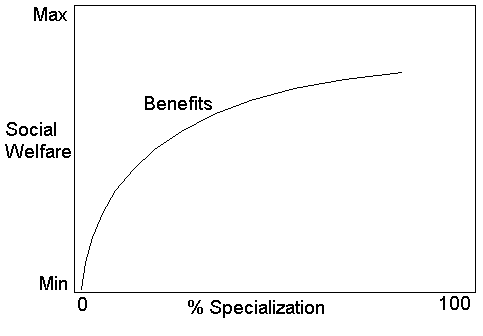
At first, with a small increase in the level of specialization, the benefits would accrue rapidly. As specialization continued to increase, however, the marginal increases in benefit would level off, and decline, tending ultimately towards zero. The cumulative gross benefit to society from specialization is shown by the area under the curve.
The marginal costs of specialization can be described by the curve in Figure 2.

At first, the costs are minor, but as specialization continues, the side-effects begin to snowball, and the curve rises steeply. Total societal costs are represented by the area under the curve.
Social welfare can thus be depicted by Figure 3, which combines the costs and benefits of specialization.

The area between the curves represents the benefits minus the costs, which is the cumulative net social well-being created by increasing specialization. We want to make this "well-being" area as big as possible, so we do not want to continue to specialize beyond the balance point, signified by x. If we move further to the right, we lose societal well-being.
Of course, the balance point denoted by x is elusive...
- It depends on what societies value. Do they want comfort or challenge, peace or glory in war? Will they emphasize material wealth or spiritual wisdom? How will wealth be distributed?
- We don't know exactly what the benefits and costs of specialization are, nor do we understand fully how they interrelate.
- Individual costs and benefits do not equal societal costs and benefits.
- There are substantial lags between the changes themselves and the gathering of evidence of their effects.
However, even though we don't know exactly where the balance point is, it is still useful to try to increase the benefits and decrease the costs of a given level of specialization, i.e. shift the curves out further.
Indeed, many technological inventions, social programs, and management innovations we have seen through the years have been designed to do that very thing. For example, the introduction of coins as the standard means of exchange reduced the costs of transactions and facilitated further specialization. The wheel, and much later the clipper ship, the steam engine, and the tractor-trailer rig reduced the cost of exchanging goods. The Pony Express and e-mail were both designed to reduce communication lags.
Specialization in History
The specialization model we have described seems to be borne out by history. Herbert Spencer, a noted social philosopher of the nineteenth century, remarked on this:
Whether it be in the development of the Earth, in the development of Life upon its surface, in the development of Society, of Government, of Manufactures, of Commerce, of Language, Literature, Science, Art, this...evolution of the simple into the complex, through successive differentiation, holds throughout.
With the first "agricultural revolution," the planting and harvesting of crops, came a great leap in specialization. Corfield and Keene observed that "...the emergence of permanent towns, regular trade, and settled agriculture marked a significant consolidation of occupational and locational specialization." This specialization happened throughout much of the world, and gave rise to the first cities (that we know of) in the great river valleys of China, India, Egypt, and Iraq.
Many labor-saving devices -- windmills, watermills, levers, wheels, pulleys, screws, sails -- were in wide use long before the 17th century. These technologies were adopted by individual craftsmen or guilds to improve their work. They supported a considerable degree of specialization in agriculture, milling, mining, transport, and many other industries.
The Industrial Revolution, catalyzed by the power of steam, built on this technological base. The importance of machinery grew relative to the importance of skilled labor. Technology grew in scale and price, and factories expanded, dramatically altering the production of goods and services, and thus society. Skilled workers became more specialized, subdividing into groups of mechanics, engineers, toolmakers.
For the individual entrepreneur, the benefits of industrialization were enormous; it allowed a producer to create a greater supply of goods at lower cost, to distribute them widely, and to amass wealth and power. There were also societal benefits from this new level of specialization: the quality of output was standardized, cost of production per item dropped, greater variety of goods and services were made available, new techniques were perfected, and slavery became less profitable.
Yet some of the side-effects of industrial specialization were intolerable, creating intense pressure for social welfare legislation, trade unions, universal suffrage, child labor laws, pollution controls and other attempts to shift the cost curve.
Specialization and Taylor
As the Industrial Revolution rolled on into the late nineteenth century, an influential machinist-turned-industrial-engineer Frederick W. Taylor developed the practice of "scientific management", furthering specialization in the context of work. Taylor believed that most factory workers did not have the knowledge needed to manage their own work. Instead, trained industrial planners were responsible for analyzing work scientifically, with time and motion studies, and designing tasks based on the results. Motivation for the worker was derived solely from his paycheck which, according to Taylor, was all that workers cared about.
Taylor's system worked. The specialization benefits curve shifted upwards, and productivity rose sharply, as scientific management was widely adopted as the way to organize business. Indeed, practices based on scientific management are still being used in many industries today.
As with most changes in specialization, the initial benefits were quickly realized, while the resultant changes in the costs curve were not apparent for some time. Yet those specialization costs were very real. The bad side-effects of Taylorist organization began to dog the U.S. economy, imperceptibly at first, but in increasingly high-profile ways at least as early as the 1950's. As Thomas Stuelpnagel says,
Top managers lost their hands-on feel for their products and, as a result, got too far away from their customers. This change occurred when businesses grew and...functions within the companies gained enough power to assume more importance than the products. The change was accelerated when control passed to second- and third-generation managers who had financial and marketing backgrounds rather than engineering and production backgrounds.
There were other bad effects: hardening of labor-management division, boredom, resentment at externally-determined standards, and the miscommunication and complexity that came with growth. According to Joseph Juran,
A further mighty development during this century has been the growth of public suspicions and fears relative to the negative side of industrial progress.
In sum, it was these side-effects which pointed out the need for new ways of thinking and acting. It is the failings of one paradigm that spurs the search for a new one.
Metacraftsmanship as Response to Specialization
There is an old Oriental proverb that says, "When the student is ready, a teacher will appear."
The degree of specialization which we have in modern economies is higher than ever before. The benefits of this have been realized, and the bad side-effects are surfacing. The students are ready.
The teachers are appearing. The pioneers of the newest management philosophy were mostly industrial engineers and industrial psychologists working in large companies. Shewhart, Deming, Juran, and Lewin all worked for AT&T Western Electric. Ishikawa worked for Kawasaki, and Taguchi for Nippon Telephone and Telegraph. Perhaps the weaknesses of Taylorist work models became visible earlier in very large companies. Perhaps these companies simply had the wherewithal to hire the best minds and to turn them loose.
Whatever the case, these thought leaders worked on real-world problems and ran experiments to test their new theories. As they gained understanding, they began to teach and publish their new methods. They explored ways to tap the creativity of their workers, and to encourage the flow of information through their organizations. They focused on quality circles, ongoing education, statistical process control, and continuous process improvement. They learned from one another, and gradually pieced together a new organizational fabric, commonly called Total Quality Management (TQM).
Japanese companies were the early devotees of the new philosophy, starting in the 1950's. The striking success of Japanese firms has been the dominant economic news story of the past forty years. In electronics, automobiles, shipbuilding and other industries, Japanese manufacturers got more, better production from a lower capital investment than American companies were getting. They seemed also to achieve this with lower social costs and higher social benefits.
Most Western companies were not generally tuned in to the ideas of quality management. They proposed various reasons for poor results - older plants, less cooperative workers, unequal terms of trade. But Japanese companies opened factories overseas, and soon their managers got the same results in older buildings with American and European workers as they were getting in Japanese plants.
The difference was clearly in management. Some Western companies awoke to this fact, and started to make changes of their own, modeling their Japanese counterparts. Most of those that acted promptly survived. The complacent firms did not.
There is, of course, a caveat. TQM has its detractors and skeptics, and there have been many failures in its implementation. Consultants with little understanding jumped on the bandwagon, leading to expensive failures. Companies have rolled out TQM programs, trained people in its methods, and raised expectations without really making basic changes in values, behaviors or work practices. TQM withered in these situations, and as a result, there is in many places a suspicion of and distaste for it.
Yet, where it has been well-executed, TQM has worked very well indeed. It works in America, in Europe, in industry, in healthcare, in government. The quality of products and services has increased sharply, design cycle times are reduced, and customers get more opportunities to be heard.
We are certainly not at an end-state; we haven't mastered TQM. We shouldn't really expect to; its whole emphasis is on continuous improvement. Yet even at this relatively early stage, we are inclined to agree with Joel Barker, who in his famous book "Paradigms", calls TQM the most important paradigm shift of the twentieth century.
The Organization as Metacraftsman
The dissemination of TQM ideas in the U.S. since 1980 has unleashed a flood of interest, research, practice, and results. Ideas from different disciplines have been extracted, weighed, and combined to advance the original theories. Some old ideas from the ancient Greeks, Henry Ford, and John Dewey have been revived. Variations and extensions include CQI, re-engineering, systems thinking, and hoshin planning. The movement that began with TQM has grown and changed.
A more encompassing philosophy is taking shape today that enables us to cope with specialization and systemic complexity. The dust is far from settled, and many innovations doubtless lie ahead, but the outlines are emerging. William O'Brien, in an essay in "The Fifth Discipline Fieldbook" says, "Now, I believe, a new wave is forming: the beginning of a twenty-first century era which is yet unnamed." Brian Joiner also perceives this new wave, calling it "Fourth Generation Management", having superseded 1) management by doing, 2) Taylorism and 3) management by results.
I believe that the underlying aim of modern management is to help a large complex organization function as if it were one craftsman. Craftsmanship is an old concept, but one which is appreciated in all cultures, and which is rich enough to hold many of the new ideas which are coming together in the 1990's. In craftsmanship, we see art and technology harmoniously combined, and the worker finding self-actualization in the work.
When we have many people aligned in working towards craftsmanship, we have chosen to call it metacraftsmanship. "Meta" is one of those prefixes that people bandy about without being quite sure what it means. We sought help from The American Heritage Dictionary, which offers 10 definitions. Here's the one we like:
Meta = Beyond; transcending;
Together, "meta" and "craftsmanship" imply some transcendence or enrichment of the work of the traditional craftsman. We see Fourth Generation Management, or metacraftsmanship as an essential weapon in the struggle to improve our businesses, our society, and ourselves.
For an overview of the principles of Metacraftsmanship, follow this link.

SkyMark is a software company based in Pittsburgh, Pennsylvania which focuses on creating software tools that help people improve the way they work.
Useful Links
2026 © SkyMark Corporation. All Rights Reserved.