

Kaoru Ishikawa: One Step Further
Kaoru Ishikawa wanted to change the way people think about work. He urged managers to resist becoming content with merely improving a product's quality, insisting that quality improvement can always go one step further. His notion of company-wide quality control called for continued customer service. This meant that a customer would continue receiving service even after receiving the product. This service would extend across the company itself in all levels of management, and even beyond the company to the everyday lives of those involved. According to Ishikawa, quality improvement is a continuous process, and it can always be taken one step further.
With his cause and effect diagram (also called the "Ishikawa" or "fishbone" diagram) this management leader made significant and specific advancements in quality improvement. With the use of this new diagram, the user can see all possible causes of a result, and hopefully find the root of process imperfections. By pinpointing root problems, this diagram provides quality improvement from the "bottom up." Dr. W. Edwards Deming --one of Isikawa's colleagues -- adopted this diagram and used it to teach Total Quality Control in Japan as early as World War II. Both Ishikawa and Deming use this diagram as one the first tools in the quality management process.
Ishikawa also showed the importance of the seven quality tools: control chart, run chart, histogram, scatter diagram, Pareto chart, and flowchart. Additionally, Ishikawa explored the concept of quality circles-- a Japanese philosophy which he drew from obscurity into world wide acceptance. .Ishikawa believed in the importance of support and leadership from top level management. He continually urged top level executives to take quality control courses, knowing that without the support of the management, these programs would ultimately fail. He stressed that it would take firm commitment from the entire hierarchy of employees to reach the company's potential for success. Another area of quality improvement that Ishikawa emphasized is quality throughout a product's life cycle -- not just during production. Although he believed strongly in creating standards, he felt that standards were like continuous quality improvement programs -- they too should be constantly evaluated and changed. Standards are not the ultimate source of decision making; customer satisfaction is. He wanted managers to consistently meet consumer needs; from these needs, all other decisions should stem. Besides his own developments, Ishikawa drew and expounded on principles from other quality gurus, including those of one man in particular: W. Edwards Deming, creator of the Plan-Do-Check-Act model. Ishikawa expanded Deming's four steps into the following six:
- Determine goals and targets.
- Determine methods of reaching goals.
- Engage in education and training.
- Implement work.
- Check the effects of implementation.
- Take appropriate action.
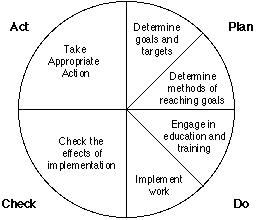
- Ishikawa. K., (Lu. D. J. trans.), 1985, What is Total Quality Control?, Prentice-Hall Inc., Englewood Cliffs, NJ.
SkyMark's Management Tools Page: Cause and Effect Diagrams

SkyMark is a software company based in Pittsburgh, Pennsylvania which focuses on creating software tools that help people improve the way they work.
Useful Links
2026 © SkyMark Corporation. All Rights Reserved.