
Affinity Diagram
The affinity diagram, or KJ method (after its author, Kawakita Jiro), wasn't originally intended for quality management. Nonetheless, it has become one of the most widely used of the Japanese management and planning tools. The affinity diagram was developed to discovering meaningful groups of ideas within a raw list. In doing so, it is important to let the groupings emerge naturally, using the right side of the brain, rather than according to preordained categories.
Usually, an affinity diagram is used to refine a brainstorm into something that makes sense and can be dealt with more easily. In Seven New QC Tools, Ishikawa recommends using the affinity diagram when facts or thoughts are uncertain and need to be organized, when preexisting ideas or paradigms need to be overcome, when ideas need to be clarified, and when unity within a team needs to be created.
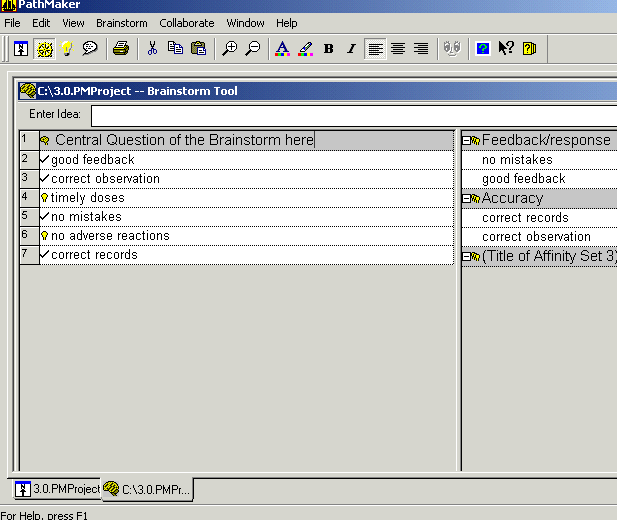
A sample affinity diagram is show below. On the left side of the window is a brainstormed list of ideas. On the right side is the affinity diagram, in which ideas have been grouped into affinity sets. In this case, the sorting is in an advanced state, and affinity sets have already been given titles. It's important not to add the titles early in the sorting process.
Affinity Diagramming: Steps
To create an affinity diagram, you sort the brainstormed list, moving ideas from the brainstorm into affinity sets, and creating groups of related ideas.
As you sort ideas:
- Rapidly group ideas that seem to belong together.
- It isn't important to define why they belong together.
- Clarify any ideas in question.
- Copy an idea into in more than one affinity set if appropriate.
- Look for small sets. Should they belong in a larger group?
- Do large sets need to be broken down more precisely?
- When most of the ideas have been sorted, you can start to enter titles for each affinity set.

SkyMark is a software company based in Pittsburgh, Pennsylvania which focuses on creating software tools that help people improve the way they work.
Useful Links
2026 © SkyMark Corporation. All Rights Reserved.